Why Journal Prompts Stop Working (And What to Use Instead)
Why journal prompts stop working, and what to use instead
I first sent this to readers of my weekly letter, The Words We Live Inside. If you would like it in your inbox a week earlier, along with a word art print to keep, you can join for free here.
I gave myself a rule instead of a question
My journal had gone flat and the prompts were making it worse. Here's the daft experiment that fixed it.
I'd stopped journalling. Not decided to, just stopped.
It took me a while to admit why. When I did sit down I wrote the same three lines I always write. Tired. Grateful. Hope tomorrow's better. Then I'd close the book feeling like I'd done something, and nothing had actually moved.
So I tried prompts, because that's what you're told to do. What are you grateful for. What went well this week. What would you tell your younger self.
They made it worse.
A prompt asks a question, and a question shapes the answer before you have started. You read "what are you grateful for" and you already know. My health. My people. A roof. All true, all written down before, all written down again. The question had done the deciding for me and I was just filling in the form.
So one night I did something different. No question. I gave myself a rule.
Write about today without using a single word for a feeling.
That was it. No drained. No overwhelmed. No grateful. And because I couldn't reach for any of them, I had to put down what actually happened instead.
The third cup of tea gone cold on the side. Answering the phone in a different voice. Standing in the kitchen at ten past four not really doing anything.
I read it back and barely recognised it. It was still me. It just wasn't the version of me I usually write down.
Here's what I think is going on, and it took me a while to work out. When you write freely, part of your brain is steering. Choosing what's worth saying. Tidying it as it goes. And that steering part has habits, which is exactly why you keep landing in the same place.
A rule gives that part of your brain a job. It's busy counting words, or avoiding a letter, or working out what a Tuesday costs in pounds and pence. And while it's busy, something honest gets onto the page unsupervised.
It isn't a new idea.
In 1960 a group of writers in Paris called themselves Oulipo and spent decades arguing that a constraint isn't a limit on creativity, it's the engine. One of them, Georges Perec, wrote a whole novel without using the letter e. The same man later sat in a square for three days and wrote down only what went past. They pointed it at literature. I've pointed it at a notebook on a kitchen table.
This is the same thinking behind the word art I make, where every word describes something already true rather than instructing how to feel.
So I made more of them.
Write today as a shopping receipt, with prices. Write the washing instructions for yourself, like the label in a jumper. Write a lost property notice for something you've lost that isn't an object. Write the minutes of a meeting that happened entirely inside your head.
There's 160 of them now, across two decks.
You shuffle, take one without looking, and do what it says. And that bit matters more than it sounds. You don't get to pick, because the one you'd pick is the one that already suits your mood, and the one that suits your mood is the one that already sounds like you. The whole point is to end up somewhere you wouldn't have gone.
There's a second little pile too. Twelve modifiers, which sounds far more complicated than it is. A card gives you one rule. A modifier gives you a second one on top.
Draw the receipt card. Then add "in exactly six words". Now you're writing a six word receipt. Same card, completely different evening. Twelve of those against a hundred cards is twelve hundred combinations, which I didn't plan. I just did the maths one night and sat there quite pleased with myself.
And you don't have to be a writer for any of this. There's nothing to be good at. You're filling in a form. If you can fill in a form you can do every single card in there.
One more thing, because it's the bit I care about most. If a card produces nothing, that's a result, not a failure. Put it back and draw again tomorrow. Nothing in this is a streak you can break.
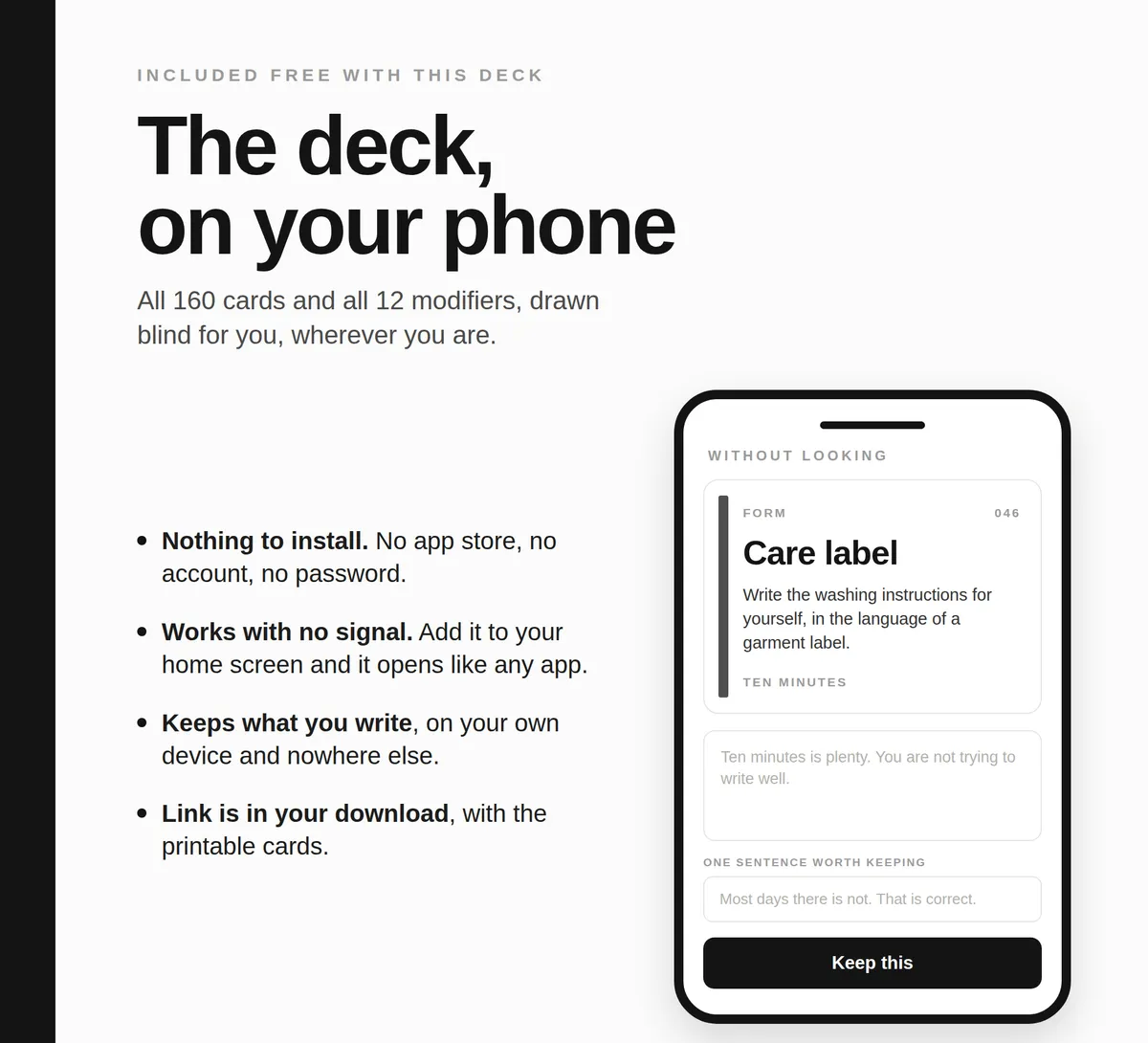
They're printable, so you could have them on your desk tonight, and a free app comes with them so the deck's on your phone when the cards are at home. I've had a proper printed set made for myself too, and holding them is a different thing altogether. Still hunting for a really good card printer though, so if you know one, tell me.
The decks
Ways In: 100 cards — the original hundred, £14.34
Further In: 60 cards — volume two, the stranger ones, £9.54
Both decks: 160 cards — everything, including the twelve modifiers, £20.34
All printable, all with the free app. Print them tonight if you want to.
Watch your words come alive.
P.S. Prints and commissions live here: http://wordartbysarahbailey.etsy.com. If you are looking for a memorial portrait made from your own family's words, that is there too.
Before you go
I am Sarah Jane Bailey. I have a master's in mental health psychology and a degree in English, and I make word art: portraits and prints built entirely out of words, where the words themselves do the work of the light and the shadow. Every word in every piece is chosen on purpose.
If something here landed, the weekly letter goes further into it. It is called The Words We Live Inside, it is free, and there is a word art print waiting for you when you join.
Join here: thewordsweliveinside.substack.com
Prints and commissions live at wordartbysarahbailey.etsy.com, including memorial portraits made from a family's own words for someone they have lost. That is the work I am proudest of.