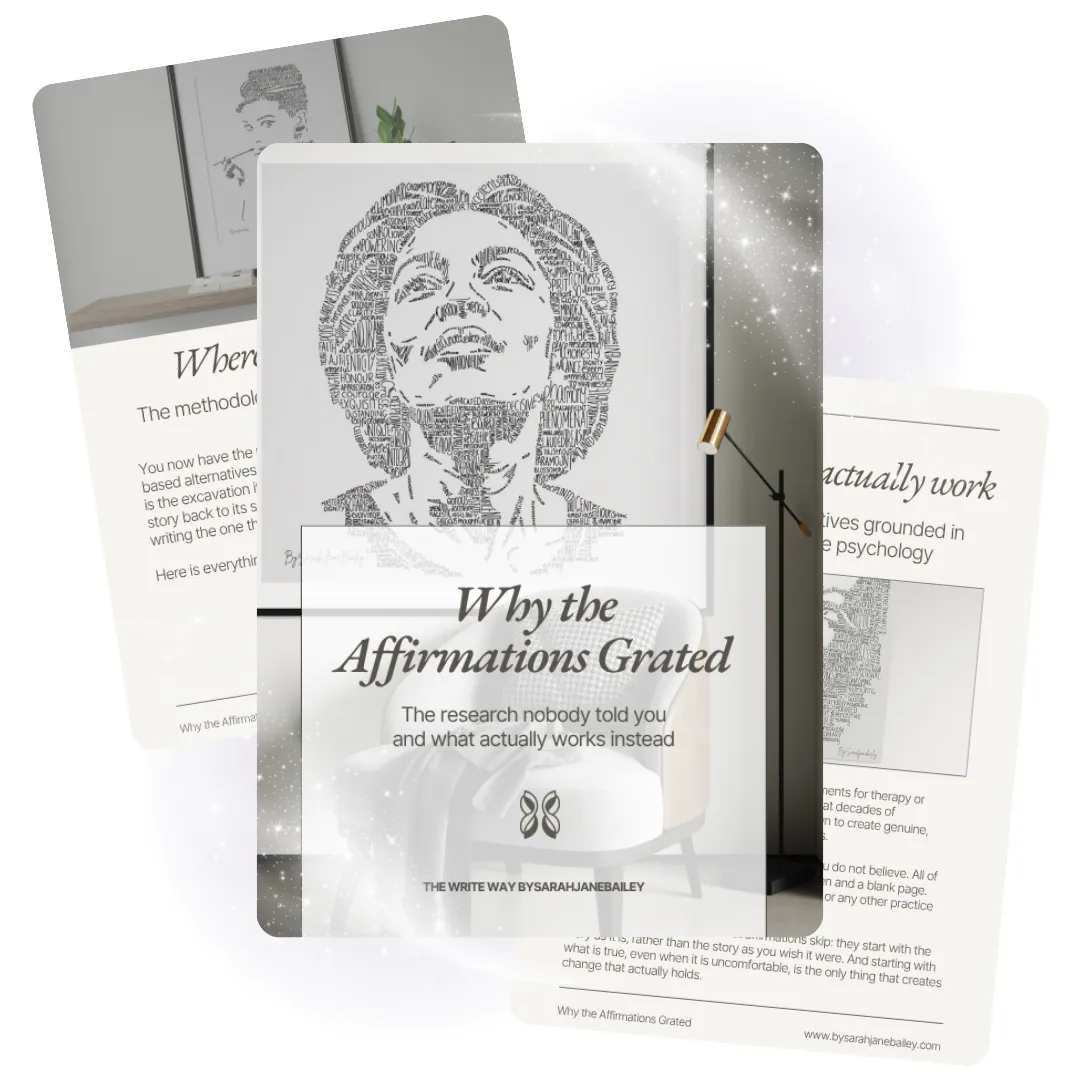
Why the Affirmations Grated — and What Actually Works Instead
Why the Affirmations Grated — and What Actually Works Instead
There is a moment I want to ask you about.
You are somewhere quiet. A mirror, perhaps. Or a journal, early in the morning, before anyone else is awake. And you say the words you have been told to say.
I am enough. I am worthy. I am capable. I am loved.
Words you have read in books, seen on walls, repeated with genuine effort and genuine hope. And underneath them — quietly, persistently, with a stubbornness you cannot quite override — something that refuses to be convinced.
They grate.
Not dramatically. Just quietly. Like wearing someone else's clothes and being told they fit perfectly.
You were not getting it wrong. The affirmations were missing something fundamental. And what they were missing has been documented in psychological research for decades — it just never made it into the self-help books.
I know this territory from the inside. And I know it from the research. I am Sarah Jane Bailey — an Amazon bestselling author with a Master's in Mental Health Psychology from the University of Liverpool. I create psychologically intentional word art and self-discovery tools for women who have tried the tools and are still, underneath everything, quietly stuck.
This is the post I wish someone had written for me twenty years ago.
The research finding that should have changed everything
In 2009, psychologist Joanne Wood published a study in Psychological Science. She asked participants to repeat a simple positive self-statement: 'I am a lovable person.'
The results were the opposite of what the affirmation industry would have predicted.
People with high self-esteem showed a modest improvement in mood. But people with low self-esteem — the people who most needed the affirmation to work, who had the most at stake — felt measurably worse. Not neutral. Actively worse.
The mechanism is straightforward once you understand it. When a positive self-statement directly contradicts an existing belief, the brain generates a counter-response. It is not being difficult. It is doing exactly what brains are designed to do: protecting the internal coherence of the story it has already built about who you are.
The gap between what you assert and what you actually believe does not close when you repeat the affirmation. It widens. The act of asserting the positive statement highlights the discrepancy so clearly that the existing negative belief is actually reinforced by the attempt to override it.
This is why the words grate. Not because you are weak, or resistant, or not trying hard enough. Because the affirmation is trying to install a new story on top of an unexamined one. And a story installed on top of an unexamined one is not a rewrite. It is decoration.
The step the self-help industry keeps skipping
Here is the question the affirmations never asked.
Why do you believe you are not enough? When did that become the verdict? Whose evidence was it built from? In what circumstances was that story assembled — and were those circumstances actually a reliable source of truth about who you are?
Because here is what I have come to understand, both through my psychology training and through my own journey: the beliefs that the affirmations were aimed at were not formed in adulthood. They were built in childhood, from the reflected appraisals of the people who shaped your earliest understanding of yourself. From the messages — spoken and unspoken — about who you were, what you were capable of, what you deserved, whether you belonged.
Those messages became a story. And that story became so familiar, so deeply embedded in the way you interpret every experience, that it stopped feeling like a story at all. It started feeling like the truth.
Years ago, a therapist handed me a piece of paper. On it were eight beliefs she had identified from our sessions together. I read them sitting in a car park and I sat there for a long time — not because they surprised me, but because seeing them written down was the first time I understood: these are not facts. They are beliefs. And beliefs have a source.
The eight beliefs on that piece of paper
I am a failure.
Good things happen to others.
Everyone will leave me.
I do not belong.
I am not enough as I am.
I have to do it alone.
I am not likeable.
I am not worthy.
Read those slowly. Mark any that you recognise — not as an idea, but as a feeling you know from the inside.
These are the beliefs that the affirmations were trying to override. And now you understand why 'I am enough as I am' does not land when 'I am not enough as I am' has been running quietly underneath everything for thirty years: the belief is too old, too well-evidenced by the story's carefully curated archive, too loyal to simply step aside because you said the opposite thing in front of a mirror.
The affirmation skips the most important step. The excavation. The understanding of where the story came from. The careful, honest examination of whether it was ever actually true.
What I built instead — and why
That piece of paper was the beginning of everything I have made since.
I started making word art — portraits of women built from the words that described who they actually were, underneath the story. Not aspirational words. Not words to aspire toward. Words that were already true, that the story had simply covered over.
The first piece I made was called She. A woman's profile, filled with gracious, fierce, vibrant, fearless, enough. I made it before I had language for why it mattered. Before I understood, in the terms I have now, that the words we encounter in our environment every day shape our self-concept quietly and continuously — that environmental priming research has confirmed we do not need to consciously repeat a word for it to influence how we think about ourselves.
The art was the integration layer. But what the car park moment showed me was that the work had to begin somewhere else entirely. Not at the rewrite. At the excavation.
That is what the Narrative Archaeology methodology is built around. Five layers — from seeing the story you are currently living in, back to where it was built, through the evidence of who you actually are, and forward into the consciously chosen story you want to live in. Grounded in 40 years of research from Pennebaker, McAdams, and White. Made accessible for the woman who is not in therapy and does not need to be — but who is ready to do the actual work.
Five things that actually work — and the free guide that explains them
The alternatives to affirmations are not complicated. They are just honest. They start with the story as it is, rather than the story as you wish it were. And starting with what is actually true — even when it is uncomfortable — is the only thing that creates change that actually holds.
Here are the five approaches covered in the free guide:
One — Excavate before you rewrite
Before trying to change what you believe, understand where that belief came from. Name the story. Find its central sentence. Follow it back to its source. Dan McAdams' research on narrative identity shows that this meaning-making is not dwelling — it is the mechanism of genuine change.
Two — Values affirmations instead of trait affirmations
Instead of asserting what you are ('I am enough'), affirm what you care about ('integrity matters to me'). Values statements do not trigger the brain's dissonance response because they do not require you to believe something you do not yet believe. They are already true.
Three — The fair witness practice
A fair witness is not a cheerleader. She looks at the full record — every achievement, every competence, every moment of showing up — and reports accurately on what is there. Not the curated version, the story that has been kept. The whole thing.
Four — Expressive writing
Pennebaker's research, replicated in over 300 studies, shows that writing honestly about significant emotional experience produces measurable improvements in psychological well-being. Not because of emotional release — because of meaning-making. The brain building coherence from fragmented experience.
Five — The environmental layer
The words you see every day prime your nervous system before you have formed your first conscious thought. Not as affirmations. As a daily, low-level encounter with the language of who you actually are. This is the research behind every piece of word art I make.
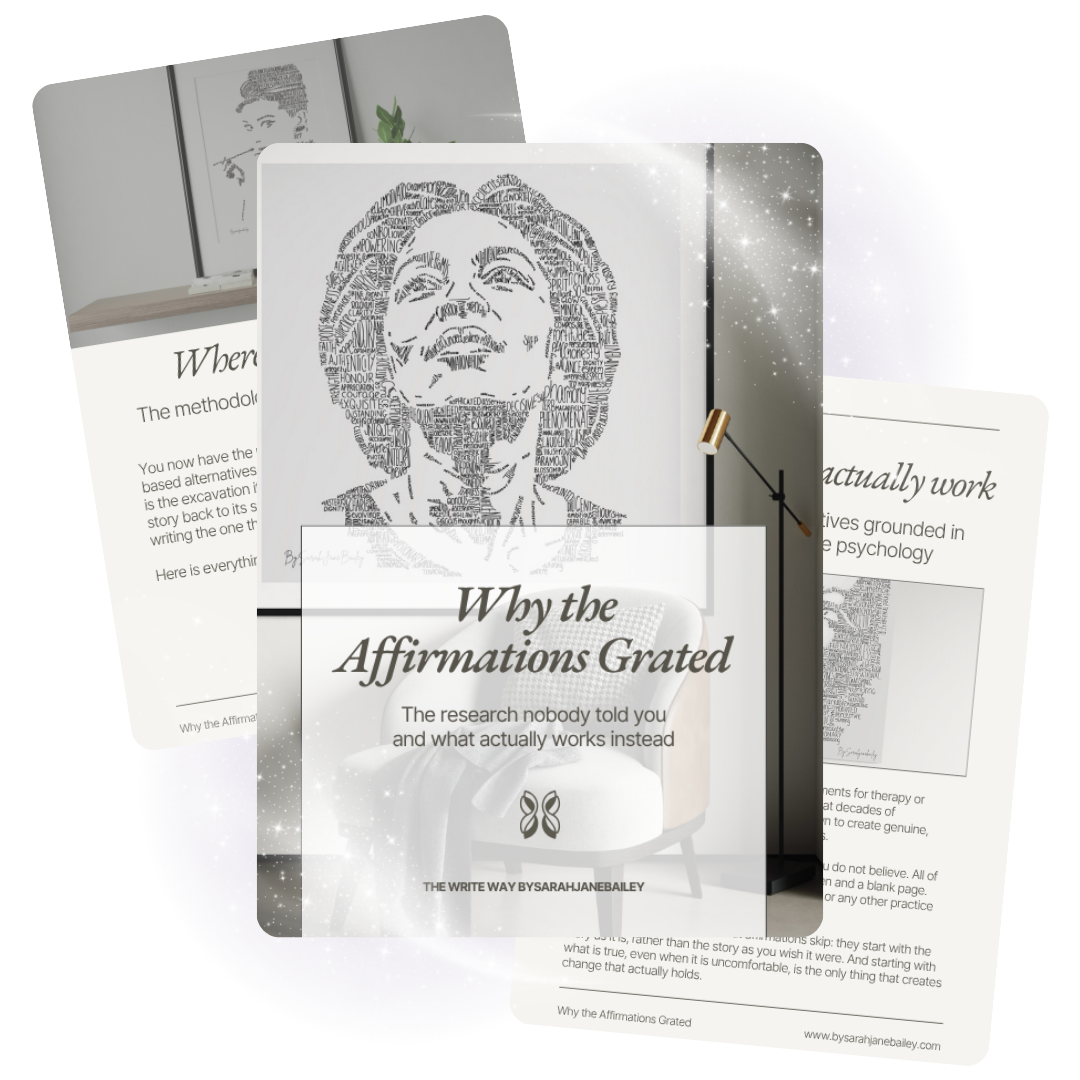
The free guide — Why the Affirmations Grated — covers all five in full, with the research behind each one and exactly how to begin. It also includes the eight beliefs list and an introduction to the Narrative Archaeology methodology.
It is free. It is instant. And it will give you the language for something you may have been feeling for a very long time without knowing what to call it.
Where to go from here
If this post has landed somewhere true, there are a few places I would invite you to go next.
The free guide is the beginning — the research and the five alternatives, delivered immediately to your inbox.
Download it here.
If you want to go deeper into the methodology, The Write Way is the home of Narrative Archaeology — the complete five-layer framework for the excavation, the rewrite, and the integration. The book, The Plot You Inherited, takes you all the way through it.
And if you want the words on your walls to be doing something deliberate — not just decorating the space but quietly, continuously priming the self-concept you are choosing — the word art collection at bysarahjanebailey is where that lives. Every piece is psychologically intentional. Every word was chosen for what it activates, not just how it looks.
The word at the centre of all of it:
Enough.
Because she always was. The story just made it very hard to see.
Download the free guide
Why the Affirmations Grated: The Research Nobody Told You, and What Actually Works Instead.
Five evidence-based alternatives. The eight beliefs list.
The first step of the Narrative Archaeology methodology.
Free. Instant.