Why You Feel Like You Don't Belong: 5 Layers Down
Why You Feel Like You Don't Belong — and the One Sentence Underneath It
Pick one belief. The same belief, all the way through. Five layers of work on the same sentence.
Layer One — The Surface (How the belief sounds in your adult life)
Layer Two — The Stratum (Where the belief was built)
Layer Three — The Bedrock (The actual evidence)
Layer Four — The Rewrite (Conscious authorship)
Layer Five — The Integration (The chosen words in daily life)
I am going to walk you through one belief, the one I have heard the most often in my own work, and the one that comes up most often in readers' replies. I do not belong.
If this is not the one running underneath your life, the structure still holds. Substitute another. The shape is the same.
Layer One — The Surface: How the belief sounds in your adult life
The Surface is the version you live with. It is not the belief said out loud. It is the way the belief shapes your actual sentences and choices. For I do not belong, it sounds like this in the wild.
You arrive at a thing you were invited to and stand at the edge of it for the first ten minutes. You do not introduce yourself to anyone. You wait to see if anyone will recognise you and absorb you in. If no one does, you leave early and tell yourself the parking was complicated. You do not register the small panic that drove the leaving.
You join a group of competent, friendly colleagues and immediately position yourself as the helper. The one who gets the coffees. The one who keeps the spreadsheet. The role of the helper is the role of the person who has earned the right to be in the room, even though no one ever told you the right was contingent.
You watch a friend talk easily across a dinner party and feel a small, hot recognition that something has been given to her that you do not have access to. She is in the room in a way you are not. You file the observation as proof.
These are Surface evidence of the belief. Not the belief itself. The fingerprint.
Layer Two — The Stratum: Where the belief was built
The Stratum is the layer underneath the Surface, where the belief was built. Not in adulthood. In the architecture of childhood, in the reflected appraisals of the people who shaped your earliest sense of who you were and what you deserved.
For I do not belong, the Stratum question is not, did anyone tell me I did not belong. The Stratum question is, where in the geometry of my early environment did belonging quietly fail to be reliable.
It might be the family that prized one sibling visibly more than the other. It might be the school where the social codes were never fully explained to you, and the moment of asking was the moment you proved yourself the outsider. It might be the parent who was emotionally present in fragments rather than constantly, so the belonging was real when it was real and absent when it was absent, and you developed a permanent low-grade vigilance about whether you were currently in or currently out.
It might be all of the above. It might be none, and the inheritance was carried over a generation by your mother, who had a reason of her own.
The Stratum work is honest excavation, not blame. The point is to see the architecture clearly. Not to assign moral weight to the people who built it. Most of them inherited it from their own architects.
Layer Three — The Bedrock: The actual evidence
The Bedrock is where the work changes. The first two layers were diagnostic. This one is corrective.
The Bedrock is the layer at which you become a fair witness to the actual evidence of who you are.
Not the inherited story. Not the Stratum. The actual record.
The fair-witness list
I want you to do one thing and do it carefully. Make a list of every relationship in your current adult life — friend, colleague, family, romantic, casual, in which the other person has demonstrated, repeatedly and in their own choices, that they choose to spend time with you.
Not that they are polite to you. Not that they tolerate you. That they choose you.
Now read the list.
The list is the evidence.
The inherited belief said you do not belong. The list says, repeatedly, that you do. People with their own time and their own choices and their own competing demands keep electing to spend their time near you.
The fair witness does not say, but they would leave if they really knew me. The fair witness says, this is the actual evidence, and the actual evidence does not match the inherited sentence.
This is uncomfortable to do. The inherited story has been running for thirty years. It does not surrender to a single contradicting list. But the list creates the first stable place to stand from which a rewrite can hold.
Layer Four — The Rewrite: Conscious authorship
The Rewrite is the conscious authorship of the new sentence.
Not an affirmation. An author's choice.
For I do not belong, a rewrite that holds is something like: the people in my life have chosen, repeatedly, to be near me, and I am allowed to take that as evidence rather than as a fluke. Not poetic. Specific.
The Rewrite has to be small enough to be true. I belong everywhere will not hold. In the rooms I am in, by the choice of the people in them, I belong here will hold.
Layer Five — The Integration: The chosen words in daily life
The Integration is the chosen words in daily life.
This is the layer most self-help skips and the layer the methodology takes most seriously.
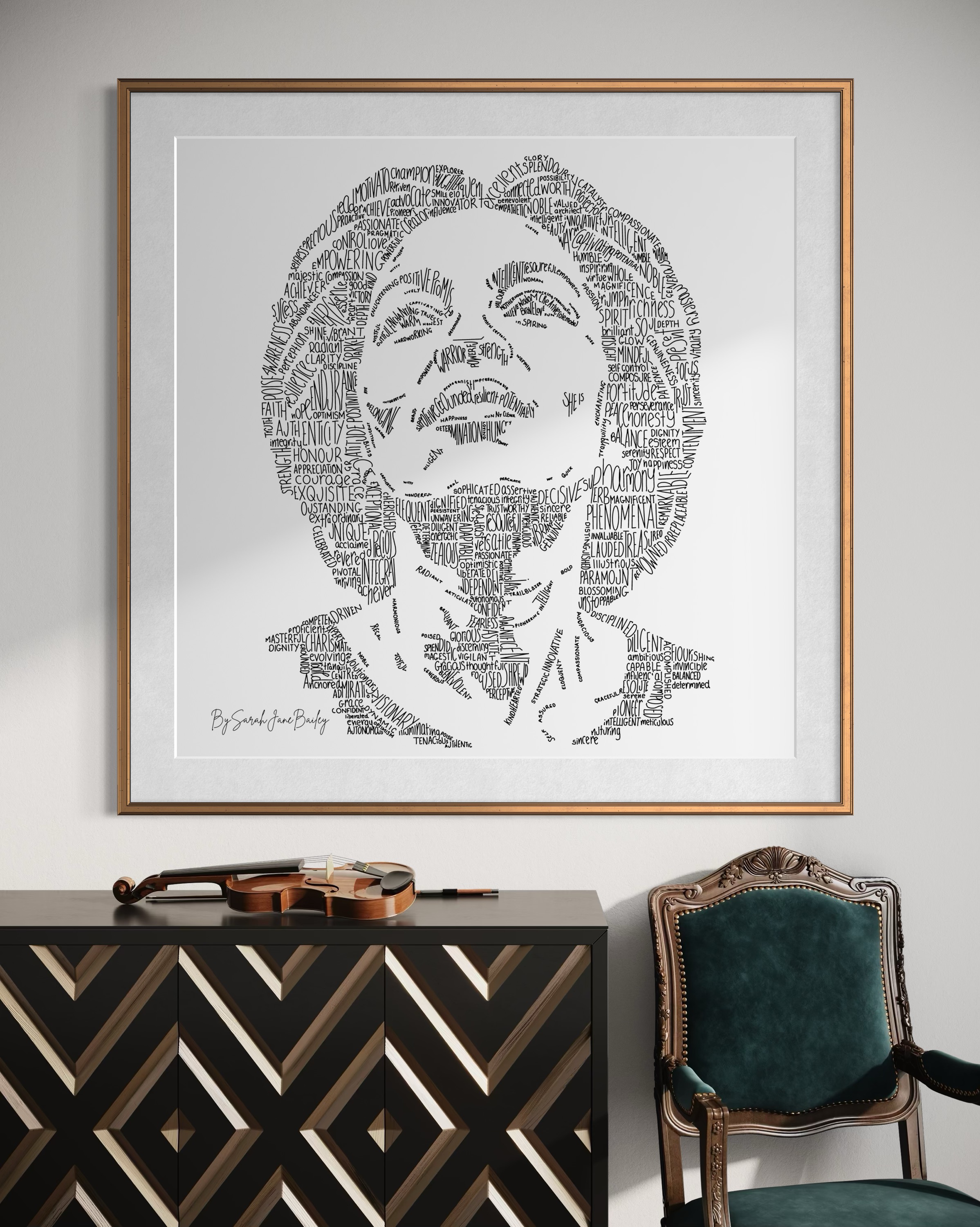
It is the morning practice. The phrase you write at the top of your journal. The sentence on a card on your desk. The portrait above the kettle, built from chosen words rather than inherited ones, which your eye lands on every time you fill it.
The chosen words have to live in your environment, not in your discipline. Your discipline is finite. Your environment is constant.
This is what the art was built to do.
One belief. Five layers. Any of the eight.
You can run any of the eight through the same shape.
The story that has been running your life was never the whole truth. It was an inheritance. And you have always had the right to examine it.
Get my free guide 'Why Affirmations Grate' at https://www.bysarahjanebailey.com/freeguide
Before you go
I am Sarah Jane Bailey. I have a master's in mental health psychology and a degree in English, and I make word art: portraits and prints built entirely from words, where the words themselves do the work of light and shadow. Every word in every piece is chosen on purpose.
If something here landed, the weekly letter goes into it further. It is called The Words We Live Inside; it is free, and there is a word art print waiting for you when you join.
Join here: thewordsweliveinside.substack.com
Prints and commissions live at wordartbysarahbailey.etsy.com, including memorial portraits made from a family's own words for someone they have lost. That is the work I am proudest of.